Rules For Spirits
2025-12-05
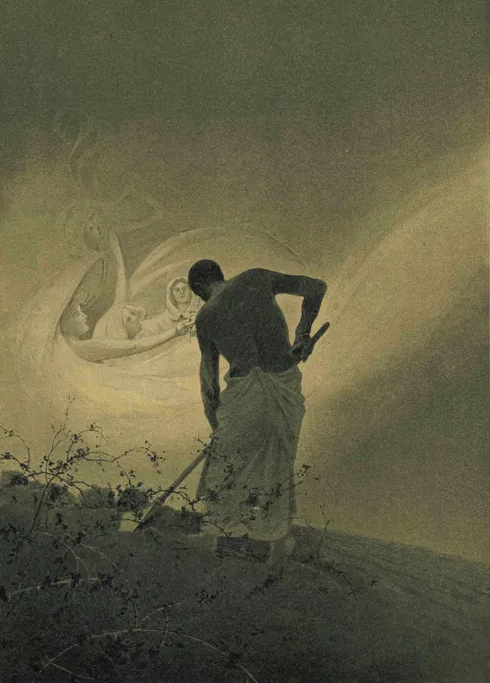
Illustration By Raffaele Mainella - Nos Invisibles
“What senses do we lack that we cannot see or hear another world all around us?”
- Dune, By Frank Herbert
This article is a revision and companion to the Ramblings of The Spirit World article I wrote sometime back, nothing in this article changes the cosmology outlined there, but the specific mechanics for how spirits interact with physical reality are fairly different.
The primary goal of these rules was to have a procedure for how and when spirits can interact with physical beings in a way that wasn’t just tied up with the creature’s statblock or played out via GM fiat.
When I was running my playtest campaign for my system Be Not Afraid, while spirits can come up, they were fairly infrequent so mostly handled the way most OSR systems handle them, however as players started using powers and abilities that would make it easier to contact, command, or talk with spirits it became clear I needed more of a consistent procedure for this. That all came to a head when an antagonist of the campaign started employing the ghost of a person the players had killed.
While it made for an interesting and spontaneous threat, as well as a means for the big bad to keep tabs on the players, there wasn’t really a way to counter it besides the players getting lucky. The only sure-fire way they had to avoid being spied on was to be on holy ground, the players using the local Catholic Church as a meeting place.
They eventually dealt with the ghost after it decided to possess a person who was in a coma, but that is another story. After that had all been wrapped up I quickly jotted down some rules (mind you, not super coherent rules) for spirits and how they can interact and visualize physical things.
I had also been playing a good deal of Quasimorph at the time, and was quite inspired by how it handled the barrier between worlds, hence why the different Veil levels were largely inspired off the names for different quasimorphosis levels. I’ve largely scrapped that element in favor of simplicity, as they’d fit better as in-universe terms as opposed to a game term.
Another goal I had in mind with these rules was the ability to use them with spirits from existing OSR and D&D books. I will note these rules will make certain spirits a good deal less deadly, but also a bit harder to deal with, and while you don’t have to use the cosmology these rules are designed with in mind, they still largely replace how things like the Border Ethereal work, so do keep that in mind.
Veil Strength
The Veil is the barier which divides the physical universe from the spiritual universe, it’s largely what protects humanity and physical entities from the total predations and interventions of spirits. The general strength of the Veil corrosponds to human activity, the more intense and dense human actviity the stronger the Veil is that area, the further from civilization the thinner the Veil is.
Other things may also strengthen or weaken the Veil in an area, night time and darkness tend to lower the Veils strength slightly, certain celestial events such as exclipses or equinoxes, certain times such as the Witching Hour or Good Friday, generally these alterations to the Veil are -2 to +2, and in more extreme cases -4 to +4.
| Veil Strength | DC (Veil Level) | Typical Context |
|---|---|---|
| Weak | 10 | Countryside or “haunted places” |
| Average | 15 | Standard towns or suburban locations |
| Tough | 20 | Urban environments |
| Hardened | 25 | Inner city |
Certain powers or actions require a spirit to fight against the Veil, throwing their metaphysical weight against it to achieve some end. This is called a Veil Check.
-
*A spirit rolls d20 + ½ HD (rounded down) vs the Veil DC.
-
A spirit can make a number of Veil Checks per day equal to its HD.
A spirit can gain circumstantial modifiers to their Veil Check, a spirit of rage for example attempts to manifest a specific power during an active riot, thus gaining a +4 to the check as it feeds off the emotional resonance.
Veil Clarity: The Liminal overlaps with physical reality and it’s geography, in some sense the Liminal is a state of being as opposed to a layer of reality. However beings in the Liminal do not get a perfect view of our side of things, sound is often quite muffled and doesn’t carry very far, visuals can be slightly blurry to downright hazzy as a spirit tries to see something. this effect strenghtens with the local Veil level, a Veil of 10 doesn’t obstruct a spirits view much if at all, where as a Veil level of 20 or 25 is like trying to see through stained glass.
Movement in The Liminal: In the Liminal unless a spirit has a specificed flight speed, can typically hover 30 feet off any adjacent surface in the physical world, this also means they can scale and float up through any structure, likewise they can hover at any height they are at, though cannot ascend further unless an adjacent structure permits.
Spirits can also phase through any structure, creature, or object at half their normal movemnt speed.
Spirit Manifestation Levels
Spirits are almost entirely made up of material that cannot support its own existence within the physical world, be that ephemera, ectoplasm, ather or whatever techno-spirit babble explaination one desires, The Veil resists their intrusion even after they cross, their body needing effort to maintain corporeal solidity.
When a spirit attempts to manifest it pushes itself through the Veil, some spirits don’t have the power to fully become real some only manifest as a dim presence, a subtle shift in atmosphere, the contrast of the room changes, maybe the tempature drops or raises, subtle voices just out of the range of audible, or shadows dark across the periphery of perception.
Other times the spirit is caught halfway, appearing as a translucant but still mostly incorporeal form, your typical ghost encounter is often like this, forced against the Veil, a projecton of what is on the otherside.
occasionally a spirit musters up the might or conditions in which to fully manifest, in such instances they manifest for themselves a fully incarnate body
| Degree | Level | Description | |
|---|---|---|---|
| 1‑3 | 1. Presence | Sense only, incorporeal, invisible | |
| 4‑8 | 2. Apparition | Visible, incorporeal, limited interaction | |
| 9+ | 3. Manifestation | Corporeal, full Interactaction |
-
Presence: A spirit in this state is pushing up against the Veil, while this state they are fully invisible and incorporeal but can preceive things on the other side with full clarity afforded to their senses. perceptive or spiritually sensitive creatures may notice temperature changes, briefly spot the spirit in a mirror, or notice it out of the corner of their eye.
-
Apparition: The spirit is partially through the Veil, while still mostly incorporeal, they are now visible, often in a translucant or dim fashion. in this state they get a plus +4 for Veil Checks to interact with things or use their powers.
-
Manifestation: The spirit is fully manifested, creating a temporary body for itself in which to operate and can fully interact with physical reality for the duration of their manifestation. A spirit that is fully manifested is not required to make a Veil Check to use their powers or actions (unless otherwise specificed)
-
The duration for a spirits manifestation is 10 minutes x the spirits HD. so a spirit of 3 HD can stay manifest for 30 minutes before requiring another Veil check to stay at their level of manifestation.
-
Spirits that are any level of manifested have their Veil Check limit suspended for the duration of the manifestation.
Interaction with spirits: AS A general rule of thumb if a spirit can touch you, you can touch it and vice versa. Holy/Magic weapons or items may also interact or harm spirits even on the ohterside of the Liminal, however only if the wielder can preceive the spirit in question.
Oppression & Possession
Oppression
Spirits may exert metaphysical pressure upon a creature, influencing its emotions and thoughts to bring them into closer resonance with the spirit. This effect is called Oppression.
To Oppress a creature, the spirit must first succeed on a Veil Check. If successful, the target must immediately attempt a Will Save.
- Success: The creature resists the influence and is immune to further Oppression attempts by that spirit for the remainder of the day.
- Failure: The creature gains 1 level of Oppression and suffers –1 to all future Will Saves against Oppression and –1 to any Saves or checks related to stimuli aligned with the spirit’s nature (e.g., Oppression from a spirit of fear imposes penalties to resist supernatural fear effects).
Each level of Oppression represents growing spiritual resonance and weakening of the creature’s defenses.
Possession
Once a creature has accumulated enough spiritual vulnerability (typically 3 levels of Oppression, or the threshold specified in a spirit’s description), the spirit may attempt to Possess the creature.
To attempt Possession, the spirit must first succeed on a Veil Check. If successful, the target must immediately make a Will Save (Vs. Spell), applying all penalties from Oppression.
- Success: The spirit fails to take control and may not attempt Possession again until the next day (unless its description states otherwise).
- Failure: The spirit enters the host’s body and gains control for a duration based on the degree of failure the creature failed by.
| Degree of Failure | Duration |
|---|---|
| 1–4 | 1d6 × 10 minutes |
| 5–8 | 1d6 hours |
| 9+ | 1d6 days |
When the possession’s duration ends, the host immediately makes a Will Save to repel the spirit.
-
Success: The spirit is expelled and may not attempt Possession again until the next day.
-
Failure: The possession continues, and the host remains under the spirit’s control for another interval of the same duration.
-
After 3 consecutive failures: The spirit becomes fully anchored and remains until forcibly removed.
-
While Possessing a creature the possessing spirit uses the host’s HD, AC, Saves, Movement, and physical attacks, but may use its own supernatural abilities unless otherwise noted.
-
Damage to the host does not harm the spirit.
-
Killing the host expels the spirit (or destroys it, if its folklore or mythology it comes from specifies).
Effects that Target the Spirit: Certain spells or supernatural effects can target the spirit instead of the host body, in such instances HD or saves of the spirit are used instead of the Host. e.g, if Turn Undead was used against a possessing ghost, the table would use the ghost’s HD not the creature, likewise saving throws against mental effects target the spirit not the host.
Chimera
Chimera are half spirits, or rather spirits with a degree of natural physicality to them, creatures such as those of the Fae, or Djinn are considered Chimera. Unlike true spirits, Chimera once manifested do not need to make Veil Checks to maintain a physical form, likewise manifesting is a binary affair for them, if they succeed any degree at manfiesting they fully cross the Veil.
However Chimera must make a Veil Check to cross back over into the Liminal.
Other Considerations
One thing that I did want to avoid was having some sort of “spirit points” my personal preference is not overly gamifying certain mystical elements, and having what spirits can do be determined by a discrete currency they could spend and acquire felt sterile to me, hence I didn’t go that one.
I don’t have many other closing thoughts on these rules, beyond that they will likely be tweaked as I playtest them more. Things such as summoning, binding, and banishing spirits are likely going to get their own articles as some of the other magick systems of my system get fleshed out and written up.
I also am going to start producing articles that cover types of spirits, such as the ones outlined in the first article, probably ghosts being the first one as that should be fairly easy.
Inspirations
As I often do, I like to list some of my inspirations, and when it comes to other worlds and their metaphysics there is no short supply of good examples. while the Liminal specifcally didn’t take from all these sources, my wider cosmology certainly takes notes from all of these and others.
-
The Nevernever - Dresden Files
-
Realms of Power - Ars Magica 2nd/5th edition
-
The Umbra - World of Darkness
-
Twilight - Chronicles of Darkness
-
The Unseen World - Lord Of The Rings
-
The Warp - Warhammer 40k
-
The Ethereal Plane & Astral Plane - Dungeons & Dragons
-
The Wood Between The Worlds - The Magician’s Nephew / Chronciles of Narina
-
Bramfaturas - Quasimorph